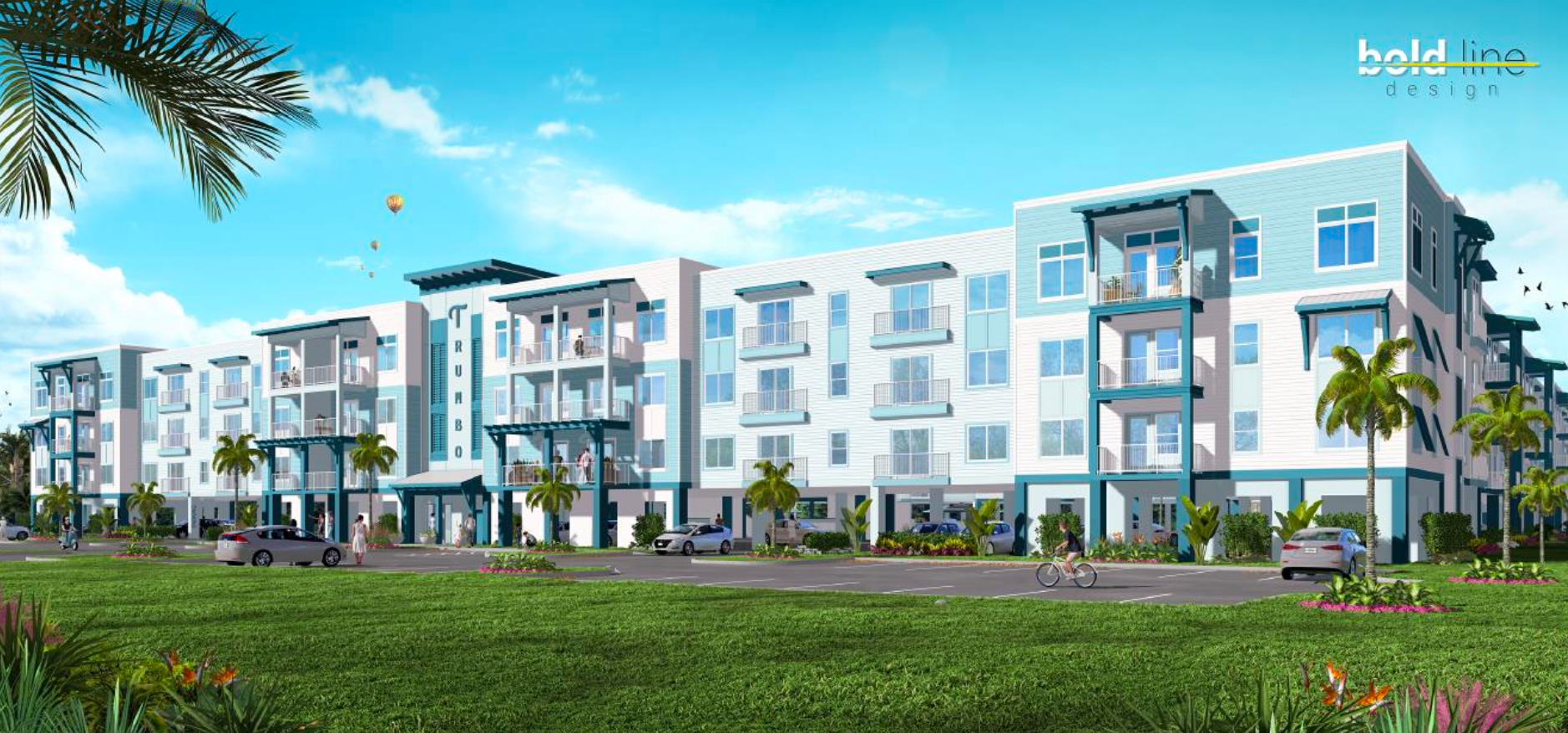
The City Commission approved The Lofts at Trumbo on May 7. One hundred and fifty deed-restricted affordable apartments for teachers and school district staff, on five and a half acres of prime downtown land where dilapidated school district warehouses have been sitting for decades. Twenty-plus years in the making. A 7-0 vote.
This is a win. A real one. Genuine congratulations to the Monroe County School District, to VestCor for getting it across the finish line, to the City Commission for moving it forward, and to the advocates and staff who hung in through every false start.
Four years ago, in the lead-up to the workforce housing referendum at the Truman Waterfront, I wrote 3 Reasons You May Not Have Thought of for Voting YES on 3.2. The argument then, and now, applauding what eventually became The Lofts at Bahama Village, came down to three reasons:
- More locals living downtown creates a more local-focused, less touristy vibe and that’s good for the historic business district.
- Housing downtown makes it easier to bike, walk, and use transit to get around.
- Not being car-dependent brings livability costs down further for residents.
Win. Win. Win.
With caveats. The transit service still isn’t real. Bike parking is a perennial afterthought. Bus stops and sidewalks and bike lanes are still pieces we keep promising and not delivering.
The Lofts at Trumbo nails the first reason. It half-delivers the second. And the third hangs entirely on choices we still have time to make. Walk with me through each in our story below.
Reason 1: 150 More Workforce Households Downtown Is a Win In Itself

For the past decade a lot of workforce housing has been built up the Keys. We’ve long argued (here and here) that the proper place for locals’ affordable housing is on this island and better yet downtown. The City delivered last fall with the opening of 126 units at The Lofts of Bahama Village, and we’ve just delivered 150 more units at the Seaport. Just as it should be.
A hundred and fifty workforce families coming downtown to live in a previously vacant area that’s been quiet too long. Families pushing strollers to the Bight on a Saturday morning. Kids riding bikes to the Truman Waterfront. People grabbing coffee at the Cuban Coffee Queen or eating dinner at Pepe’s or Schooner Wharf. The kind of local people the downtown loses every time a workforce family gives up and moves to Big Pine.
This matters in ways that don’t show up in the staff report. Downtown thrives when locals live there. The shops that depend on year-round customers, not just seasonal cruise passengers, do better when there are families within walking distance. The mom-and-pop businesses that make Key West feel like Key West get a customer base that comes back every week. Eyes on the street, weekday foot traffic, weekend strollers. Schools fill. The vibe shifts from theme park back toward neighborhood. Here’s how Paul Menta, owner of the Key West First Legal Rum Distillery and leader of the Shop Mom and Pop Key West group puts it:
“Keeping locals living locally in Key West has many advantages such as it keeps the local economy going as they buy at Mom-and-Pop type places, they have options to bike or bus to work, which takes the stress away of driving and parking, and they add to the ambiance of Key West by having locals walking around with tourists. Sounds funny but when you travel you want to shop and eat where the locals are!”
The Lofts at Trumbo delivers exactly that on a site that’s been dilapidated since most of us moved here. That alone makes this project a win. Everything else in this article is about making the win bigger.
Reason 2: Downtown Housing Should Make It Easier to Bike, Walk, and Use Transit. Mostly We Got This Right.

Here’s where the design gets a lot of credit and where the design falls a little short.
What the design got right: most of the parking sits under the building, not in a sea of asphalt around it. The architectural plans show 147 parking spaces on the ground floor — podium parking, covered, integrated into the building footprint. That’s the urban move. That’s how dense workforce housing should be designed on a small island where every square foot of land is precious – and how it should have been done in Bahama Village – height restriction be damned. There’s a smaller surface lot wrapping the Trumbo Road frontage, but the bulk of the parking is tucked away. Approach the site from any angle and you’ll see a four-story building, not a parking lot.
The location is right too. I walked from the project to the two nearest Lower Keys Shuttle stops this past week. Eaton at White: about 400 steps. Caroline at Grinnell: about 420 steps. Both walkable. Both reasonable. Downtown is a couple of blocks away. The bike network is right there.
The design also includes two ground-floor bike parking rooms, indoor and weather-protected, one near the north end of the building and one near the south. Indoor bike storage is better than outdoor — it survives the weather, it’s harder to steal from, and it puts the bikes where the residents are coming and going. That’s a real improvement over what you see at most multifamily projects in the Keys, including The Lofts at Bahama Village, where the racks are all outside.
So far so good. Here’s where it falls short.
The parking ratio. The Lofts at Trumbo will have 220 parking spaces for 150 units — roughly 1.47 spaces per unit. The City’s land development regulations require one space per unit in the historic district. The applicant chose to provide 70 more spaces than code required. Nobody at City Hall pushed back. Likely because too many officials use their own cars as a default.
The comparison that matters here is 1.5 miles around the corner in Bahama Village. Same developer. Same affordability mission. Similar central location. The Lofts at Bahama Village ended up at 99 parking spaces for 126 units — 0.79 per unit, well below code — after the City and advocates worked the bike-substitution provision in our own land development regulations, which allows four bike spaces to substitute for one car space. They added 108 bike spaces beyond the 13 required, traded 27 car spaces out, and ended up with a project that better fits how its residents actually live. Parking at Bahama Village is also tied to a pass program based on actual car ownership. If you have a car, you can get a pass. If you sell your car, you turn the pass back in. Households without cars don’t take parking spots they don’t need.
That’s the playbook. Trumbo had the same provision in the same code available to it. The conversation never happened publicly. We knew how to do this. We just didn’t.
The bike count is unclear. As best as can be read from the architectural plans in the public package, the two ground-floor bike rooms together might be able to hold somewhere in the range of 70 to 90 bikes. Plans also show smaller upper-floor rooms labeled “BIKE STORAGE” on the 2nd, 3rd, and 4th floors near the elevators. Whether residents are actually expected to lug bikes up and down four flights or use the passenger elevators with their bikes is unclear. Most multifamily buildings prohibit bikes in elevators. The Development Review Committee asked for a published count and rack style during review. That documentation has not surfaced in the public file.
No exterior visitor racks. We don’t see scooter parking either. No e-bike or scooter charging shown. A 150-unit building needs visitor racks for guests, deliveries, the kids’ friends biking over, the contractor stopping by. And e-bikes are the single biggest car-replacement tool a Key West workforce family has. The infrastructure to charge them is cheap. It should be in.

Lessons from 1.5 miles around the corner
Walk past The Lofts at Bahama Village on a weeknight at seven o’clock. The bike racks are full. Mopeds and scooters mixed in. Adult tricycles. Kids’ tricycles in bright colors. Eskute e-bikes locked next to old beach cruisers. Bikes leaning against the fence because the racks have no room left. Meanwhile, the car parking has open spaces.
This is the demand signal we should be reading. One hundred and twenty-one bike spaces for 126 units — close to one per unit — isn’t enough. Residents have already shown us what they want. They want to bike, they want their kids to bike, they want their e-bikes and scooters with them, and they want a place to put it all.
The Lofts at Trumbo is going to face the same demand. Probably more, because the bike infrastructure here is indoor and covered, which makes biking even more attractive. The City should be planning for that demand now. The 4-to-1 bike-substitution provision is sitting in our own code, available to use. Trading even 25 of the 70 surplus car spaces would add roughly 100 more bike spaces to the project, leave parking at 1.30 per unit (still above code), and bring the project closer to the Bahama Village ratio that residents have shown still isn’t enough.
While we’re at it: dedicated capacity for e-bikes with charging, dedicated capacity for scooters and mopeds with their own racks, and a real number of exterior visitor racks at both pedestrian entrances. A Bahama Village-style parking-pass system tied to actual car ownership would round it out. Households that go car-free shouldn’t be subsidizing parking they don’t use. And for the cars, are they adding electric charging for those?
None of this requires reopening the Major Development Plan. Bike capacity can be expanded into adjacent podium-parking space if some of those car spaces are substituted out. The exterior racks and charging outlets are line items in construction documents. The conversation is still possible.
Reason 3: The Affordability Promise Hangs On Transit. Right Now, That’s Where It Breaks.

The third reason from the 2022 piece was the affordability dividend — not being car-dependent brings livability costs down for the people who live in the project.
Earlier this month I wrote Housing Plus Transportation: The Affordability Math Nobody’s Doing. The short version: housing is the biggest household expense in America. Transportation is the second biggest. The Center for Neighborhood Technology puts Key West households at 56 percent of income going to housing and transportation combined, and Monroe County at 58 percent. Both jurisdictions score 0 percent “location efficient” on CNT’s index. Transportation alone runs $13,596 a year per household in Key West, $15,209 in Monroe County. Even a paid-off car costs roughly $7,000 a year to operate per Bankrate, and that climbs higher here because we have the highest gas prices in Florida and among the worst auto insurance rates in the country.
The promise of putting workforce housing downtown is that residents could trade a car for a bike, or two cars for one, and that the rent break on the affordability side wouldn’t get quietly undone by the transportation cost on the other side. Build a household around the bike network and the bus and your monthly costs drop by hundreds of dollars. Maybe more.
That’s the promise. Whether it gets delivered depends on transit working.
Right now, it doesn’t.
The Lower Keys Shuttle, which I covered in April in The Lower Keys Shuttle: From Workhorse to Racehorse, currently runs only 10 trips a day in each direction. Buses are 90 to 120 minutes apart. That’s not transit a working household can build a life around. That’s not even a backup option.
The Duval Loop, which used to circulate every 15 minutes through this neighborhood and would serve The Lofts at Trumbo beautifully, was suspended last December. The proposed North and South Connector fixed routes are still on paper, as I covered in March in Could the Duval Loop and Fixed Routes Be Returning to Key West Streets?. The on-demand Key West Rides service exists but isn’t the kind of dependable show-up-and-go convenience that competes with the car keys hanging by the door.
The Lofts at Trumbo sits on the same block as the Key West Housing Authority’s Lang Milian Apartments — 136 units of public housing that have been on this block since 1942. Together that’s almost 300 households of government-supported affordable housing on one block. The transit case isn’t theoretical. It isn’t just about the new residents coming in. It’s been overdue for the families already here.
When transit doesn’t work and parking is free and ample, driving wins. Every time. Not because residents prefer it. Because the design left them no other rational choice. And that’s the moment the housing + transportation math quietly breaks. The rent break gets eaten back by two cars parked under the building. Even if you’ll never ride the bus yourself, you’ll feel it when the teacher you depend on can’t make the math work and moves out of the Keys.
What’s Still Possible, and Where It Leaves Us

The Major Development Plan is approved. The parking count on paper is locked. But a lot is still in play, and it’s worth fighting for, both for the future Trumbo residents and for the Lang Milian families who’ve been waiting longer.
- The bike-substitution fix is the biggest piece. Use the City’s own provision to trade some of the 70 surplus car spaces for serious bike capacity, with dedicated e-bike charging, scooter and moped racks, and a meaningful number of exterior visitor spaces at both entrances.
- Open the site to White Street. The site backs up to White Street, where the developer is reportedly negotiating access through the Housing Authority’s property — a deal that would open a second egress at the signalized intersection of Palm/Eaton and White, give residents walking access to the Eaton at White bus stop, and stop funneling all of Trumbo’s car traffic toward Grinnell. The City should be at the table making sure that happens.
- Bus stop improvements baked in, not chased three years later. The City has been working on grant applications for upgraded shelters at Old Town stops. The stops nearest The Lofts at Trumbo and Lang Milian should be on that list, with shelter, seating, lighting, and the kind of design that signals these are real transit stops.
- A resident transit pass program — standard practice in cities like Arlington, Cambridge, Boulder, and Eugene and hundreds more across the country — built into the operating agreement so every household gets a free pass or two.
- Trumbo Road redesign as the obvious next candidate for the kind of resiliency treatment the City just authorized for Flagler Avenue. There are no sidewalks on Trumbo. None! There’s not bike lane either. Fix this before people move in.
- And the biggest one: bring back the Duval Loop, introduce the proposed North and South Connectors, and fund real frequency and span of service on the Lower Keys Shuttle and all the routes. Without service, infrastructure is decoration. The Loop on 15-minute headways through this neighborhood does more for the affordability of The Lofts at Trumbo and Lang Milian than almost any other single thing the City could do.
The Lofts at Trumbo is a real win. One hundred and fifty workforce families moving into downtown, on a site that’s been dilapidated as long as I’ve lived here. That matters. It matters in itself and it matters for what it says about whether we can keep doing this. The bones of the design are mostly right. The location is right. What we still choose to do — the bike capacity, the transit service, the White Street deal, and putting sidewalks on Trumbo is what determines whether the families coming soon can afford to stay here, and whether the next project gets it righter than this one did.
We just got a win for workers and a win for downtown. Now let’s make sure we finish the project in a way that the new residents can really afford to live in it by reducing their car dependence. That will contribute the final win. And everyone in Key West will be better for it.
# # #
Chris Hamilton is the founder of Friends of Car-Free Key West & Duval Street/Historic Downtown, a local advocacy group championing sustainable mobility and vibrant public spaces. Subscribe to the blog and follow on Facebook, Twitter, and Substack for updates. All stories are cross posted at KONK Life News. Originally from Washington, D.C., Chris spent over two decades leading nationally acclaimed initiatives in transit, biking, walking, and smart growth for Arlington County, VA’s DOT. Since moving to Key West in 2015, he has embraced a car-free lifestyle downtown, dedicating his time to non-profits and community projects. Explore all Streets for People column articles here.
[livemarket market_name="KONK Life LiveMarket" limit=3 category=“” show_signup=0 show_more=0]
No Comment