


The Bride!
[Showtimes and trailer at Tropiccinema.com]
 Frankenstein, the famed one of a kind 1818 novel by Mary Shelley, has given birth to countless films and plural theatrical adaptations. The story looms gigantic in our popular imagination, especially today with our collective fear of cloning and artificial intelligence.
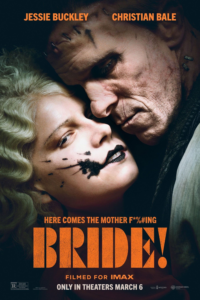
Now from Maggie Gyllenhaal (The Lost Daughter) is “The Bride!” a kind of updated chapter to the James Whale 1935 “Bride of Frankenstein”. Though it is a blues-driven mixture of tones, it is daring with an overt iconoclastic punk attitude that is refreshing in its spontaneity. However, it is also a bit too campy, comic, and cartoonish and may alienate the purists of the literary class. No matter what group you fall under, the film is free, loose, and creative with enough ample energy and sensitivity to keep your eyes wired.
In this film, events begin circa 1930 in Chicago. A gangster’s moll (Jessie Buckley) is somehow possessed by the spirit of the author Mary Shelley (also played by Buckley). The entranced woman calls out various gang members who have abused women or treated them callously. The woman is thrown down the stairs where she breaks her neck and dies.
A short time later, a man known as Frank (Christian Bale), the Frankenstein monster, seeks out the outlier scientist Cornelia Euphonious (Annette Bening) and begs her to create a lover as he is tortured by unbearable loneliness. The power in his voice is so in force that she decides to accept.
One night at a grave, Euphronious digs up the woman who broke her neck, and Frank helps the scientist electrify her to life.
The woman now has black lips smudged in a splatter (ala The Dark Knight’s Joker) and frazzled lopsided blonde hair. The woman vomits rich black paint-blood to the surprise of the doctor. Instead of a swan hiss at the sight of the male creature (so memorable in the original film) the woman bride gives a hiccup, seemingly more concerned with digestion.
Frank is immediately smitten and the bride (now named Ida) compellingly unleashes a stream of Joycean poetry about males and coupling.
Understandably, Ida is uncertain about how to proceed. After a night Frank convinces his friend to go out on the town. The two meet a trio of aggressive youngsters who attempt to assault Ida. Frank protects her by murdering the head offender, bashing him against the wall and stomping on his face.
From then on, the pair taunt a humdrum detective (Peter Sarsgaard) and his enthusiastic Lois Lane-styled partner (Penelope Cruz).
There is an arresting sex scene where Ida investigates Frank’s gorily stitched body. This is touching and affectionate as well as macabre. Surprisingly, it is not gratuitous, gross, or unreal. Though comic, it is organically so and by no means superficial.
The mated monsters go on a chaos spree if not a crime one, infiltrating a wealthy party in honor of a Douglas Fairbanks era movie star (Jake Gyllenhaal). It is here where the film becomes overly silly with Ida and Frank dancing wildly in the mode of “The Rocky Horror Picture Show” with mugged faces and wagging black painted tongues. Ida joins Frank at a cinema, where a bird roosts in her hair. Frank looks goofily at Ida and hides his eyes, as if playing peekaboo. At one point, the film mimics Mel Brooks’s “Young Frankenstein” (1974 ) as Frank dances “Puttin on the Ritz.” Such scenes ruin the existential tone of the film and risk turning the previously executed fine details into a monster mash of mush with too much going on. At points, the film is more of a Lady Gaga music video than anything by Mary Shelley, more in graphic line with Todd Phillips’s Joker: Folie à Deux’s Harley Quinn.
Despite this misstep, Jessie Buckley fully embodies the heart of a sensitive misunderstood being. Her staccato verbal gusto (part William Burroughs, part Joyce) is completely transfixing.
The blends in tone with its appropriations of The Dark Knight, slapstick Mel Brooks, Warren Beatty’s “Dick Tracy” (1990 ) and even Arthur Penn’s “Bonnie and Clyde” (1967) make a garish muddle, the wisdom of the female rises to the fore with drive, charge, and a rebel heart.
Like the aforementioned “Joker,” this film has a sociological sizzle and may offend the traditionalist, but one can’t help but applaud its wild intent and its open spirit.
Write Ian at ianfree1@icloud.com
[livemarket market_name="KONK Life LiveMarket" limit=3 category=“” show_signup=0 show_more=0]
No Comment